Afterwards
On grief, fragility, and functioning

I’ve been feeling nauseous for almost a week now, the dreaded sickness lurgy that everyone here in the UK seems to be coming down with has finally caught up with me.
I’ve of course been resting, reading, drinking bountiful mugs of lemon, ginger & honey, waiting to feel better. Coexisting alongside this has been the urge to write. The words under my skin, desperate to get out.
I’ve been toying with the idea of starting a Substack for a little while.
Like everything I do, I felt an incessant need to do it well. Forever the perfectionist.
So instead of writing and starting, I’ve spent time observing, learning the platform, scribbling notes about how I might begin.
So here I am, finally doing it.
I need an outlet.
A place to empty my head.
To unravel, in particular, the last three months of 2025.
Before I travel backwards, I need to begin in the present moment.
As I sit at my desk, waves of nausea roll back and forth, back and forth.
And yet, my brain is still translating my thoughts into language.
My fingers are still able to type these words quickly, without any need to glance down at the keyboard. The placement of the letters lives in muscle memory.
I feel quite unwell.
And I am still functioning.
My cognitive skills aren’t impacted by this sickness bug.
Thinking. Typing.
Automatic. Unremarkable movements.
Invisible processes we just… do.
I wasn’t always this attentive.
There will always be a before.
And an afterwards.
I, like so many of us, took for granted the simplicity of being able to think, type, procrastinate, move in my seat, smell the candle burning on my desk, and listen to the cars outside. All at once.
But then my mum got sick.
Specifically, her brain got sick.
And all of this changed.
One tiny protein - a prion - failed to do its job correctly. Its function isn’t even fully understood. And when one spontaneously folded the wrong way, for no reason whatsoever, it set off a devastating domino effect: irreversible and fatal.
Sporadic CJD occurs in one to two people per million annually.
It is incredibly rare.
We had one month from diagnosis.
Four weeks, exactly.
And then it was goodbye.
I want you to take your ring finger - either hand, it doesn’t matter - and touch your nose. Slowly at first, then faster. If your cognitive skills are intact, this should feel effortless. As some might say - a no-brainer.
We knew something wasn’t quite right with mum and we had her admitted to hospital. She was kept in for multiple tests, but there was one day in particular where I was truly humbled. The physio came to visit mum and began asking her to perform simple tasks, including the one I just asked you to try. My mum’s hands were shaking and she was completely off target, she nearly took her own eye out. My stomach hollowed out entirely and I knew something was really wrong.
In that moment, I also understood - viscerally - how much we take for granted.
This was all weeks before diagnosis, and I was honestly convinced mum just had a vitamin deficiency and we’d be able to turn it all around.
We then received the news.
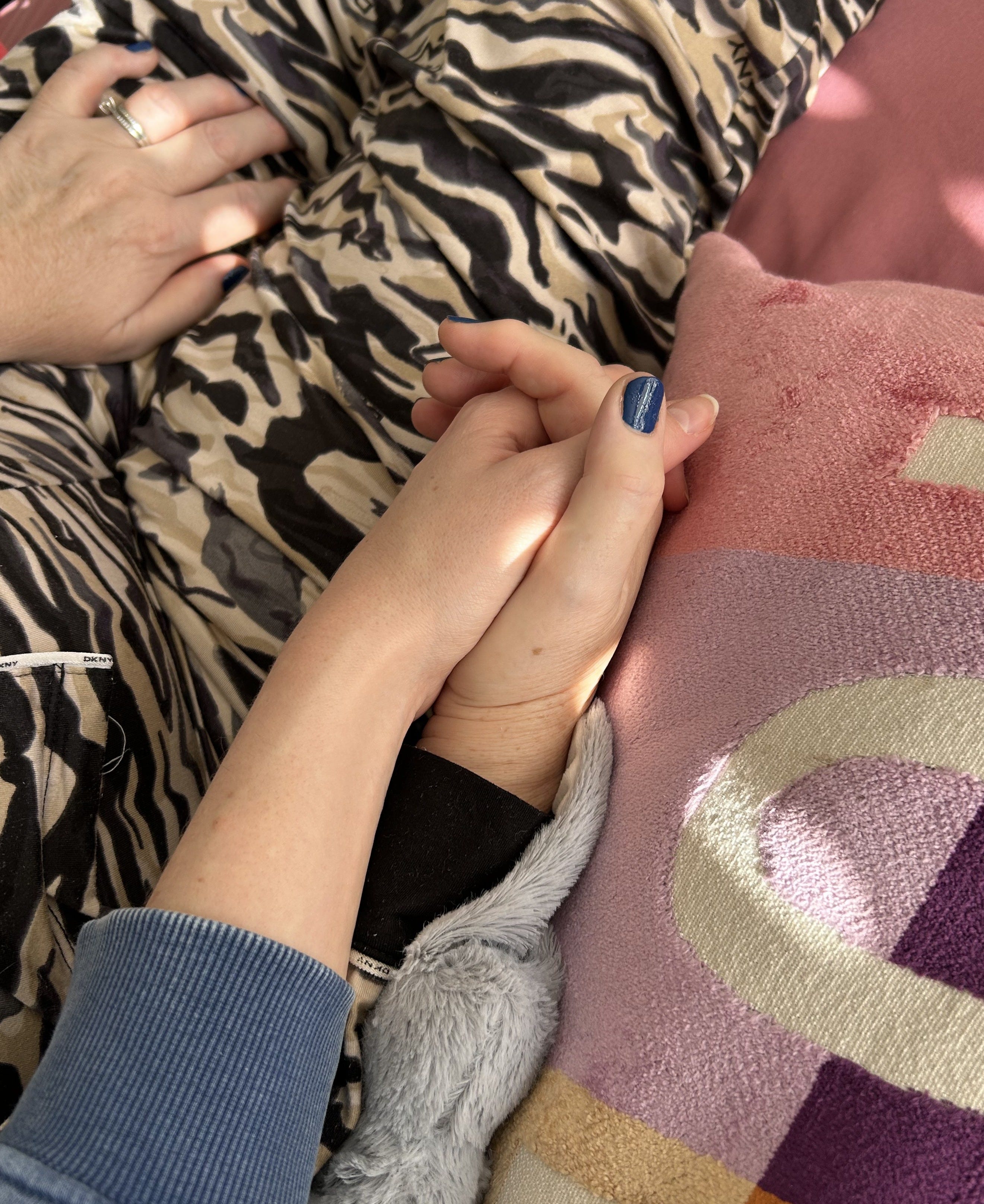
This disease humbled me in a way I don’t think I’ll ever fully be able to articulate.
I’ve seen the brain fail before. My nan and grandad both had dementia.
However, when you understand exactly what causes sporadic CJD and the speed and severity at which it moves - gratitude takes on a different shape.
When we talk about gratitude, we usually speak of it as something positive. I’m learning it doesn’t have to feel good.
Gratitude can simply mean awareness, not optimism. Shaking off the robotic state and bringing presence back to everyday functioning - the things that we mechanically, historically lose sight of.
Gratitude can mean developing a deep respect for just how many things have to go right simultaneously, for us to LIVE.
I am learning you can hold both - to be absolutely terrified and deeply grateful.
With very little to no positivity at all.
This journey taught me something my insufferable need to “stay positive” never allowed space for - that it’s okay to not be okay.
We can still hope.
Just not in the way we’re taught to.
Hope doesn’t have to mean believing everything will get better in the end. Sometimes hope simply means staying present. It allows you to keep going, when you feel like giving up. There was hope in the moments when I would brush my mum’s hair or apply her blusher. There was hope as she gobbled up her favourite custard and demanded a second portion of chocolate cake. There was hope in knowing I would not leave my mum’s side and we would get through it together.
Grief didn’t rush in all at once either, it ebbed like the tide, so gradual you barely notice, until suddenly you are knee-deep, surrounded by water. And then, without warning, pulled beneath a wave.
So many emotions. I am in awe of how much capacity we have as humans to hold all of this.
Life is so fragile isn’t it? We know this, but still, how easily we forget.
I don’t want to rush through it… I want to soak it all up. Savour it, piece by piece. Deliberately. Attentively. Not on autopilot.
And in writing, I hope to never forget. It feels like a way of remembering. Of staying present. Of not slipping back into the void.
As I slowly recalibrate and piece my nervous system back together, I’ll document what comes afterwards.
I felt every little nook and cranny of this piece. I lost my father 20 years ago (this year!) and a whole lot of growth has come along the way. What I will say, is this. Allow yourself to feel it all. There will be people who understand your grief, and those who don’t. Fill your life with people who let you talk about them. Some days you will think “I’m healing” and other days you will think “I am absolutely broken.” But two things can exist at once: you can miss the ever-loving hell out of them AND allow yourself to live life and be happy. Sending love and good wishes your way xx
This story is incredibly sad and powerful. I’m so sorry for your loss and for how fast everything happened. Grief is something very complicated. I’m still learning how to live with it myself, because it’s forever. I lost the two most important people in my life last year, and it was all very fast and painful, so from the bottom of my heart, I’m really sorry and I hope you’re doing okay.